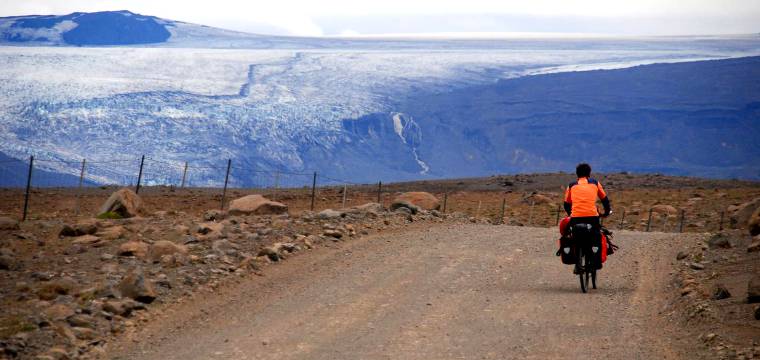
Some people are die-hard fans of bicycle touring, while others have never heard of it. Most of us are somewhere in between. We know about bicycle touring, but don’t know the details. This guide covers the important aspects and what is involved. You can navigate this guide using the links below:
Whats and Whys of Bicycle Touring
Who Can Go?
Types of Tours
Preparation
Where to Go
Packing
Heading Out
The Whats and Whys of Bicycle Touring

Bicycle touring along the southern coast of Iceland. | Image © eBicycles.com
A bike tour is any long-distance cycling trip that’s undertaken for recreational purposes. So a tour could be a two-hour cycling trip into the countryside, or it could be as long as a month or more spent visiting a scenic region.
The reason for taking a bike tour, adherents say, is obvious: it’s about the excitement of exploring a new area simply using the power of your own body. There’s a feeling of freedom that comes from being under the sky and close to nature, and it makes touring an exhilarating adventure. Because it involves long hours of pedaling, touring can be a great way to spend time with others. It’s also an activity that will quickly whip you into shape and make you feel alive within your body.
But it isn’t necessarily easy. Long tours involve hours of riding each day, and you may be carrying a heavy load on your bicycle that slows you down. With planning and preparation, however, you can determine the type of tour that’s best for you and take steps to ensure you’ll get the most out of it.
Who Can Go?

Family touring with tandem bicycles and kids. | Image © MoBikeFed (C. Helmkamp) / CC BY-SA 2.0
Bicycle touring is for anyone. Since a tour can be tailored to your abilities, you don’t necessarily have to meet any health or conditioning requirements. Children can also come along in trailers, baby seats or on a tandem, if they’re too small to ride on their own. Around age ten or twelve, they may be ready for their own bike. Riding with kids means placing less of an emphasis on covering a lot of ground, but it can still be a great experience.

Two older riders enjoy a day tour. They have side panniers on both bikes. | Stock photo © redmar
Because touring is low-impact and riders control how much effort they use, it can also be great for older riders, though some prior conditioning is useful.
Types of Tours
What kind of tour you go on largely depends on you: the amount of time you have, the distance you want to cycle each day, how much money you plan on spending, and what kind of experience you’re looking for.
Day Trips

A cyclist taking a day trip along the Pacific, on California’s Highway 1. | Image © Terry Morse / CC by 2.0
A day tour is the easiest to plan and execute. Rather than worrying about where you’ll sleep or how you’ll transport your stuff, you can set out with nothing but a small bag for essentials like a map, water, rain gear, and a simple repair kit. This is a perfect tour for someone who doesn’t have experience with long-distance rides, or who is trying to get in shape for a longer ride.
Using a sag wagon
You can take a longer trip that doesn’t involve a lot of gear by joining an organized tour using a sag wagon – that is, a vehicle that carries riders’ belongings and meets them at the end of each day. Without a heavy load on their cycles, inexperienced riders can go farther than they’d otherwise manage, and having the sag wagon allows you to bring some of the comforts of home. Paying for the car and driver raises the price of the trip, however.
Credit Card Touring

Bed and breakfast in Bryson City, NC makes for a perfect overnight stop. | Image © Lee Coursey / CC by 2.0
Credit card touring essentially implies that you won’t be bringing camping or cooking equipment; instead, you’ll purchase meals in restaurants or snack shops, and sleep in hostels or motels. You’ll still need to carry changes of clothing, toiletries, and emergency items, but you won’t be roughing it, and you won’t be completely vulnerable to the vagaries of nature. On the other hand, the costs of credit card touring can add up.
Self-sufficient Touring

Fully loaded touring bicycle parked near Bixby Creek Bridge in California. | Image © Michael / CC by 2.0
This “fully loaded” type of touring requires you to carry virtually everything you’ll need on your cycle. That includes a tent, sleeping bag, camping stove, and cooking equipment. Touring in this fashion means your bike will be loaded with gear and very heavy; you’ll find that riding it all day demands an additional level of fitness.
On the other hand, self-sufficient touring is by far the cheapest: you cook your own food and sleep in camping areas that are inexpensive or even free. Most serious fans of bicycle touring eventually wind up in this category, largely because of the excitement and challenge of being fully self-reliant.
What is a Touring Bicycle?
Finding a bicycle that’s good for a tour depends, again, on you. If you’re only planning on taking a day trip, almost any bike that’s reliable, fairly comfortable, and has a reasonable number of gears can be fine. But if you spend more than a few hours straight on your bike, you’ll realize that some elements are particularly important.
- Read more: How to Choose the Right Type of E-Bike
Frame and Gears

Rear brake and tire of a touring frame. Notice the eyelets, or braze-on’s, above and below the brakes for mounting a rear rack. | Image © Rivendell Bicycle Works
Whether you choose a traditional touring bike, such as one from Co-Motion Cycles or Bike Friday, or a mountain bike or hybrid, there are a few things to keep in mind about your bike. It needs to be light but feel solid, and it must have 21 gears or more: you’ll invariably have to ride up tiring hills and will want to put the bike into a very low gear.
Additionally, the frame needs to have holes, or “eyelets,” that allow you to fasten a rack to the frame in front and back. You won’t be able to use panniers, or saddlebags, without a rack, so the eyelets are crucial. Also make sure the frame has one or two water bottle holders already attached-you’ll need them.
Since touring bikes are specialized road bikes, so they use road bike sizing. Learn more about bicycle frame sizes.
Tires
You’ll want to use medium-width tires. While wide tires are good for dirt roads, their bumpy treads will slow you down. Narrow tires, meanwhile, tend to get flats more often.
Handlebars

Drop handlebars, with a cycling computer attached. | Image © Jason Spaceman / CC by 2.0
Riding all day will quickly teach you that handlebars providing a variety of hand positions are very useful. Drop handlebars-the curvy ones seen on racing bikes-are great for this: they allow you to rest your wrists from time to time, as well as to sit in a variety of positions.
Seat / Saddle

Brooks leather saddle, found on many touring bikes. | Image © Andy Mangold / CC by 2.0
Novices on their first long-distance tours are often surprised how much sitting all day can hurt. Finding the right seat, therefore, is crucial-but not always easy. Saddles that feel soft to the touch may not be effective for hours of riding. In contrast, hard seats can be surprisingly comfortable, and many long-distance riders swear by hard leather saddles. The best way to find a good seat is to ask around, and try a few out before making a purchase.
Bicycle Touring Accessories
On a long tour, especially a self-sufficient one, accessories aren’t optional: they’re the elements that carry your gear and protect you from harm.
Bicycle Racks

A front-mount bicycle rack installed on a touring bicycle. | Image © eBicycles.com
Bicycle racks are an essential part of bicycle touring. They install on the front and rear of your bicycle, allowing you to carry all kinds of cargo, usually via a pannier, trunk bag or basket. Visit our in-depth guide to bicycle racks to learn more.
Bags / Panniers

Waterproof pannier attached to the front rack of a touring bike. | Image © eBicycles.com
Almost all of your possessions will be packed into panniers. Before you buy them, decide whether you’ll only be using panniers on the back of your bike, or if you’ll attach a set to the front, too. If you’re not carrying a tent and sleeping bag, a set of rear panniers should be enough. But the additional equipment might require front panniers-and many long distance cyclists say adding a load on the front can actually make the bike more balanced and easier to maneuver.
You may also want to buy a small handlebar bag that allows you to easily access a few things-like a map, sunglasses, snacks, or a camera-without getting off the bike.
Fenders

Touring bike with a rear fender, panniers and rack bag. | Image © eBicycles.com
Fenders are crucial on long distance tours during and after rainy periods. Without them, the water and grit from the road will be sprayed from the front wheel onto your legs and upper body. Be careful on muddy roads, though-the fenders can clog with dirt and render you immobile.
Small Items

- Even if you’re planning on doing most of your riding during the day, make sure your bike is equipped with lights in front and back: you may eventually find yourself out after dark.
- A U-lock should be sufficient to lock up your bike; small cables can be used to secure the panniers to the bike if you leave the vehicle while it’s loaded.
- A cycling computer is also handy. It will give you current speed and distance traveled.
- You’ll want to bring a repair kit that includes a spare tube and a patch kit, as well as a few tools for making adjustments. Bring a pump, too – one that’s small and light but fills your tires completely.
Learn more about choosing bicycle accessories.
Preparation

Cyclist riding on a day trip in the Sierra Mountains. | Image © Terry Morse / CC by 2.0
So you’ve got a bike and all the accessories you think you’ll need. If the bike isn’t new, get it fully examined by a mechanic at least a week before you go. That way, you won’t encounter any surprises right away.
But the most important thing to prepare is your body. You can head off on a tour in any condition, but that doesn’t mean you’ll enjoy it. To make the first few days more fun, spend a few weeks or a month getting into shape beforehand.
Your training regimen depends on how much you already ride and how far you’re planning on going. If you haven’t been riding at all, start with five miles a day and work up from there. If you already ride a lot, you may want to start by riding twenty miles and gradually increase the distance. A good rule of thumb is to be comfortable riding, on a daily basis, half of the distance you plan on covering every day on your tour.
Cyclists’ touring distances vary widely. If you want to take it easy, observe the scenery, and stop often, you may only cover 30 miles per day on your tour. But if you’re in great shape and want to push yourself, you might do 75 or 80 miles daily. Either style can be fulfilling.
Where to Go

A handlebar bag with integrated map holder. | Image © Axiom Performance Gear
Cycling on a good day can make just about any countryside scene look lovely. While a trip across the Rockies can be spectacular, just about every region has beautiful areas that can be appreciated from your handlebars. Where you choose to go depends on how much time and money you have, what kind of experience you’re looking for, and how many hills you can tolerate.
Talk to other touring cyclists about trips they’ve done, or do some internet research on locations that interest you. Then get a good map that clearly marks back roads and potential camping areas, and spend some time examining possible itineraries.
Packing

Typical gear for an extended, self-sufficient bicycle tour. | Image © Robert Thomson / CC BY-NC 2.0
Packing can be tricky. You’ll want enough clothes, gear, and other necessities to be comfortable, but if you weigh the vehicle down, it’ll be harder to ride.
Packing for sag wagon or credit card touring is easy. For the former, you’ll barely be carrying anything on your cycle; for the latter, you’ll need a couple changes of clothes, raingear, toiletries, and a sleep sack if you plan to stay in hostels.
Self-sufficient touring is more complicated. You won’t have a good trip if you underpack, so don’t skimp. You’ll need a tent that will adequately protect you from the weather where you’re going; sleeping bag and mat; lightweight camp stove; and cooking equipment, including a pot and lid, can opener, and set of cutlery. Don’t forget smaller necessities like sunscreen and sunglasses, as well as personal items like a diary, camera, or book. Your bags could weigh 50 pounds or more, depending on the length of your trip; that may sound daunting, but you’ll appreciate being fully prepared once you get on the road.
Heading Out

A cycling group heads out on their bicycle tour | Image © Robert Thomson / CC BY-NC 2.0
After weeks of preparation, finally hitting the road can be exhilarating, whatever style of touring you’ve chosen. But it’s just the beginning of another process: learning how to adjust the tour to your needs and desires. Over time, you’ll see that some schedules are better for you than others. Maybe you like an early breakfast, then a long ride followed by a rest. Or maybe you’re someone who functions best with lots of breaks and small snacks between rides. Determining what works may simply be a process of trial and error. If you’re with others, finding a schedule that works for everyone can take a bit more time and communication.
Don’t forget to take time off to recharge now and then. Maybe the best thing about a bicycle tour is that it’s completely your own creation: enjoy the freedom that touring gives you, and design the trip to work for you.
Featured Image Credit
- Bicycle touring near glacier – Image © Vera & Jean-Christophe / CC BY-SA 2.0
Your Feedback is Important!