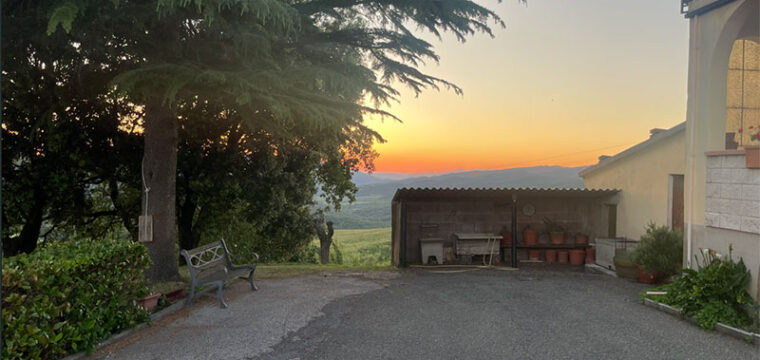
This article was contributed by our reader Kathy, who participated in the Tuscany Trail. Here are her thoughts on the experience.The Tuscany Trail is famous for its gravel roads, steep hills, beautiful villages and endless views of the Italian countryside.
But is it worth riding on an electric mountain bike?
For the 2026 Tuscany Trail, my bike of choice was the Rocky Mountain Instinct Powerplay SL A30, a lightweight full-suspension eMTB.
The idea was simple: enjoy the scenery, tackle the climbs with some assistance and experience Tuscany without spending every minute worrying about my legs.
However, riding approximately 500 kilometers on an eMTB comes with challenges that regular mountain bikers don’t have to consider.
Where can you charge? What happens if your battery runs out? Does the Italian heat affect battery range? And is a full-suspension eMTB even a sensible choice for bikepacking?
After five days on the Tuscany Trail, I had a much better understanding of what works and what doesn’t.
My Tuscany Trail 2026 Adventure
The Tuscany Trail is a self-supported bikepacking event through the Italian countryside.
It’s not a race. You choose your daily distance, riding pace and accommodation.
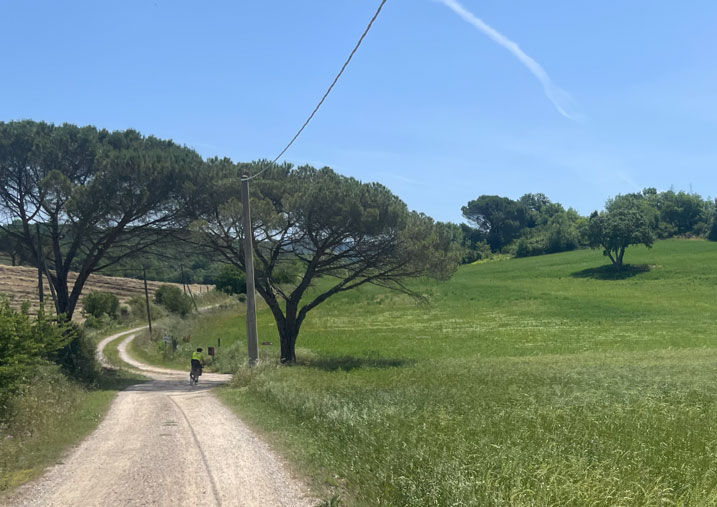
The sun shines all day (but the nights are cold)
My trip lasted five days, covering approximately 500 kilometers through a mixture of gravel roads, asphalt, forest tracks and steep climbs.
I stayed exclusively in B&Bs, which turned out to be a particularly practical decision when traveling with an electric bike.
For meals, I relied on the event’s basecamps rather than searching for restaurants along the route.
This made the daily routine relatively straightforward: ride, stop for food at the basecamps and continue to my accommodation.
But it also meant that planning the day’s distance, food stops and charging opportunities was essential.
Why I Chose the eMTB?
The Rocky Mountain Instinct Powerplay SL A30 is a lightweight-assist full-suspension electric mountain bike.
Unlike a traditional heavy-duty eMTB, the Instinct Powerplay SL is designed to balance natural pedaling with useful motor assistance.
That makes it an interesting option for long-distance adventure riding.
Its suspension provides additional comfort on rough gravel and rocky trails, while the electric assistance makes steep climbs more manageable.
The biggest compromise compared with an electric gravel bike is efficiency.
A full-suspension mountain bike has wider tires, more rolling resistance and generally more weight.
On long asphalt sections, you’ll notice that.
But on loose gravel, rough descents and uneven forest tracks, the extra control and comfort are valuable.
It’s not a dedicated bikepacking bike, but it can work well with the right luggage setup.
Know Your Charging Points
This was one of the most important lessons of the trip.
With a regular mountain bike, you can stop almost anywhere for the night.
With an eMTB, you need electricity.
And not just any electrical outlet. You need somewhere you can safely leave your bike charging for several hours.
Staying in B&Bs made this much easier.
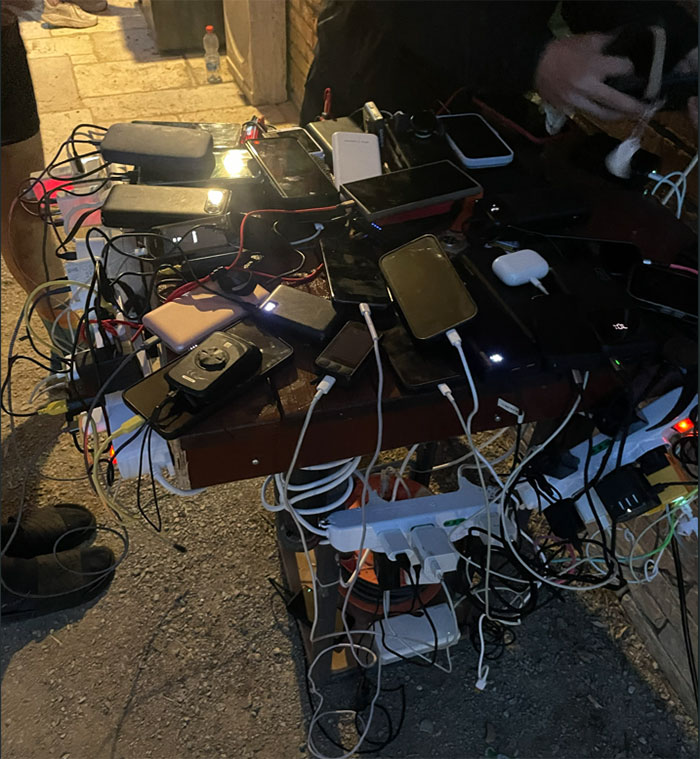
Charging your devices isn’t a problem – charging your bike can be
Every evening, the priority was finding a suitable charging opportunity before the following day’s ride.
But you shouldn’t assume that every accommodation allows e-bike charging.
Some properties have restrictions on bringing bikes indoors or charging large lithium-ion batteries inside rooms.
That’s why I’d recommend confirming charging access before booking.
Plan Around Elevation, Not Just Distance
A 70 km day with significant climbing can consume considerably more battery energy than a 100 km day on relatively flat terrain.
This matters enormously on the Tuscany Trail.
The route has plenty of climbing, and the terrain changes constantly.
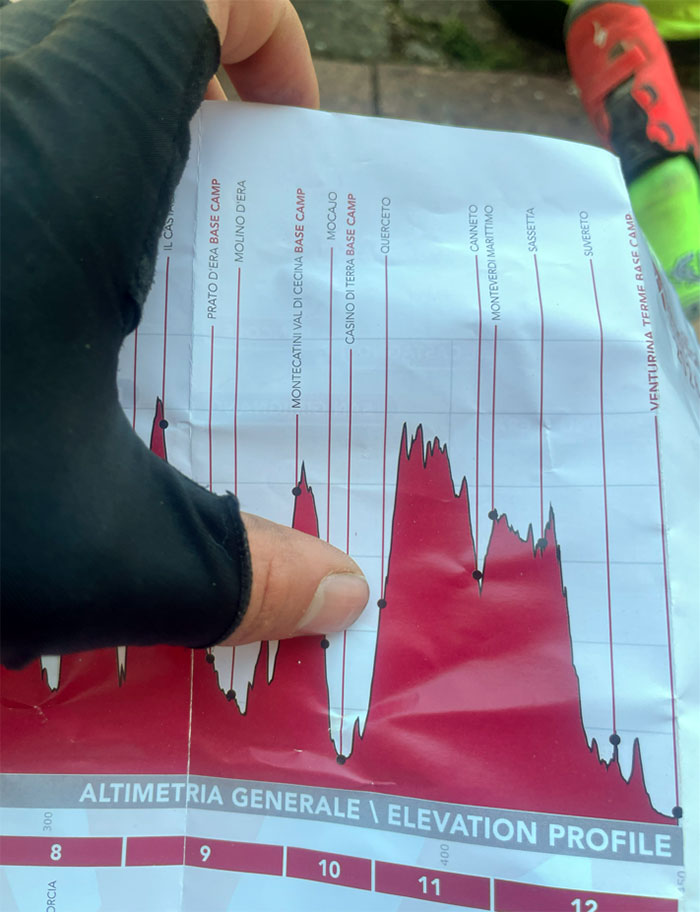
It’s just a few more miles..
Before starting each day, I’d look at three things: total distance, elevation gain and the location of the next confirmed charging opportunity.
If you can’t confidently reach the next charging point, reduce assistance or reconsider your route.
Running out of battery isn’t necessarily dangerous, but it can make an already difficult day much harder.
What Happens When the Battery Runs Out?
This is one of the biggest concerns people have about eMTB bikepacking.
Can you still ride a full-suspension electric mountain bike without assistance?
Yes.
But there’s a catch.
Even a lightweight-assist eMTB is heavier than a conventional mountain bike.
You have the motor, battery and additional components to carry uphill.
On flat terrain, riding without assistance is manageable.
On steep climbs, especially with bikepacking luggage, things become much more demanding.
Climbing Without Battery Assistance
Imagine reaching a long gravel climb after 80 kilometers of riding.
Your legs are tired, your water supply is running low and your battery is empty.
Suddenly, you’re riding a heavier mountain bike without motor assistance.
The experience isn’t fundamentally different from climbing on a conventional MTB.
You still have gears and you still pedal normally.
But you’re pushing more weight uphill.
That’s why I’d recommend saving some battery for the final climbs of the day.
There’s little point using maximum assistance on every easy hill if it leaves you without support when the terrain becomes genuinely difficult.
How Much Battery Range Do You Really Need?
Battery range is difficult to predict because so many variables affect consumption.
Your weight, luggage, terrain, tire pressure, riding speed and assistance level all matter.
Elevation is especially important.
An eMTB climbing steep gravel roads can consume energy much faster than one cruising along smooth asphalt.
Rather than relying entirely on the manufacturer’s advertised range, I’d recommend tracking your actual battery consumption during the first day.
That gives you a much more useful estimate for the remaining stages.
A Simple Battery Range Example
Here’s how battery consumption affects theoretical range for a hypothetical 480 Wh battery:
| Consumption | Theoretical range |
|---|---|
| 4 Wh/km | 120 km |
| 6 Wh/km | 80 km |
| 8 Wh/km | 60 km |
| 10 Wh/km | 48 km |
| 12 Wh/km | 40 km |
These are illustrative figures rather than measured results from my ride.
The important lesson is that small changes in average energy consumption can make a big difference over a long day.
Using less assistance on easier terrain can extend your range considerably.
Does Hot Weather Reduce eMTB Battery Range?
Tuscany can get seriously hot.
On exposed gravel roads, the sun can be relentless.
But does hot weather actually reduce an eMTB’s battery range?
The answer is more complicated than you might expect.
Lithium-ion batteries generally perform efficiently in moderately warm conditions.
However, excessive heat can cause the battery management system to reduce power or temporarily limit operation.
The battery can also become much hotter than the surrounding air during prolonged climbing.
Is a Dark Frame Bad for the Battery?
Dark-colored frames absorb more sunlight than lighter-colored ones.
A black bicycle frame left in direct sunlight can become considerably hotter than the surrounding air.
Because eMTB batteries are commonly integrated into the downtube, some of that heat can reach the battery compartment.
However, this doesn’t automatically mean a dark-colored eMTB will have significantly less range.
Battery temperature depends on airflow, frame construction, motor heat, assistance level and exposure time.
There’s no reliable percentage you can assign to the range difference between a dark and light frame without controlled testing.

Take your pick of desserts – every café has something different
What I’d Do in Hot Weather
I would avoid leaving the bike in direct sunlight during long stops.
I’d also reduce assistance when the motor wasn’t needed and allow the battery to cool before charging if it had become unusually hot.
And I’d never leave the bike charging in direct sunlight during the hottest part of the day.
The most important thing is to follow the battery manufacturer’s charging temperature limits.
Full Suspension Is Great — Until You Start Packing
eMTB has one major advantage over an e-gravel bike: suspension.
On rough gravel and rocky descents, it makes a noticeable difference.
You can ride more comfortably without absorbing every impact through your arms and back.
However, full suspension complicates bikepacking.
The rear shock occupies valuable space inside the front triangle.
That limits the size and shape of frame bags you can use.
You also need to ensure that saddle bags don’t contact the rear tire when the suspension compresses.
This is especially important on smaller frames.
Read more: How does ebikes work?
For the Tuscany Trail, I’d focus on lightweight luggage rather than trying to carry a full camping setup.
Since I stayed in B&Bs, I didn’t need to carry a tent or bulky sleeping equipment.
That made packing considerably easier.
The Elevation Was the Real Challenge
Tuscany looks peaceful in photographs.
Rolling hills, vineyards, medieval buildings and narrow roads winding through the countryside.
But those hills are relentless.
The climbs aren’t always particularly long, but they keep coming.
And on an eMTB, every climb becomes a decision about battery use.
Do you save energy and climb slowly?
Or use more assistance and risk running low later?
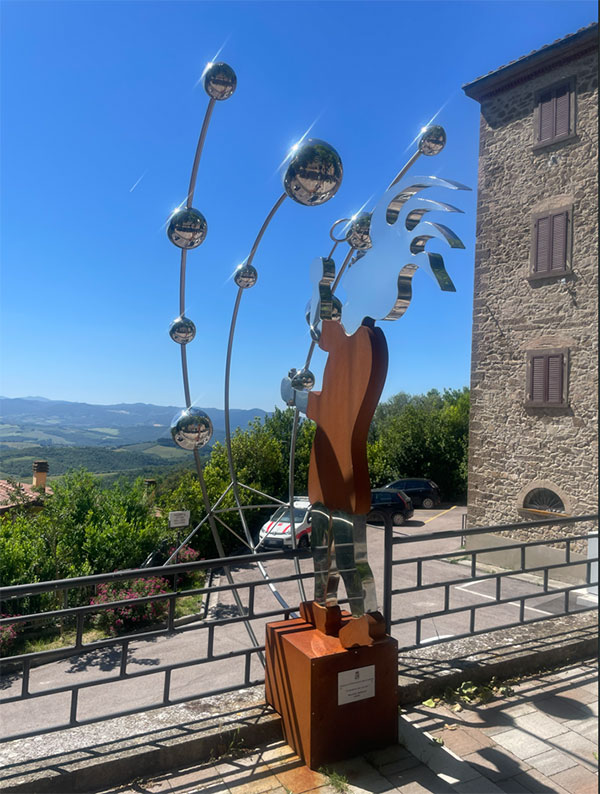
At the top of the mountain, there’s a village with an art monument
The motor assistance makes climbing more manageable, especially on loose surfaces where maintaining momentum is important.
But it doesn’t eliminate the physical effort.
You’re still pedaling for hours, carrying equipment and dealing with the heat.
The motor simply helps distribute that effort more comfortably throughout the day.
What I Packed
Because I stayed in B&Bs, I could keep my equipment relatively simple.
There was no need for a tent, sleeping bag or camping chair.
My main luggage consisted of a large saddle bag, hydration backpack and smaller bags for essentials.
The setup included:
- A large saddle bag for clothing and personal items
- A 4-liter hydration backpack
- A small top-tube bag for my phone and money
- A frame or accessory bag for tools, spare parts and snacks
- The eMTB charger
- Basic repair equipment
The charger is an unavoidable extra compared with a conventional mountain bike.
But traveling without camping equipment more than compensates for that additional weight.
On a full-suspension bike, keeping luggage compact also improves handling.
Is an eMTB Better Than an E-Gravel Bike for Tuscany Trail?
Both can work well, but they offer different experiences.
An e-gravel bike is generally faster and more efficient on smooth gravel and asphalt.
An eMTB provides more comfort, traction and control on rough terrain.
| eMTB | E-Gravel Bike | |
|---|---|---|
| Rough gravel | Excellent | Good |
| Rocky descents | Excellent | More demanding |
| Asphalt efficiency | Lower | Higher |
| Long climbs | Strong assistance | Depends on motor |
| Luggage space | Limited by suspension | Usually better |
| Comfort | Excellent | More terrain-dependent |
| Riding without assistance | Heavier | Usually easier |
| Technical trails | Better suited | More limited |
For riders who want to explore rougher routes beyond the Tuscany Trail, an eMTB is a more versatile choice.
However, if you’re mainly interested in long-distance gravel touring, an e-gravel bike is probably the more efficient option.
What Would I Change Next Time?
There are several things I’d do differently on another eMTB adventure.
First, I’d confirm every overnight charging opportunity before starting the trip.
Second, I’d pay more attention to elevation profiles rather than planning daily distances based on kilometers alone.
Third, I’d conserve battery on easy sections.
I’d also make sure to have a reliable backup navigation device.
And finally, I’d keep my luggage as light as possible.
Staying in B&Bs rather than camping was a good decision for this type of trip.
It simplified charging, reduced luggage weight and made recovery between long days much easier.
Final Verdict: Is Tuscany Trail Worth Riding on a eMTB?
Yes. The Tuscany Trail is a great destination for a lightweight-assist eMTB.
The combination of gravel roads, rough tracks, steep climbs and beautiful scenery makes electric mountain biking particularly enjoyable.
Full suspension adds comfort on difficult terrain, while motor assistance helps make the relentless climbing more manageable.
But the battery adds another challenge.

The desserts are delicious!
You need to know where you’re going to charge, how much elevation lies ahead and when to conserve assistance.
And when the battery runs out, you’ll still have to pedal a heavier bike uphill.
For me, staying in B&Bs and eating at the basecamps was a practical combination.
It meant I could enjoy the event atmosphere while having a comfortable place to sleep and charge the bike.
Would I recommend riding the Tuscany Trail on an eMTB?
Absolutely.
Just remember that electric assistance doesn’t remove the adventure. It changes the way you plan it.
Your Feedback is Important!